
Pole Rage® Programmes
Structured training plans built around your pole goals.
Rather than figuring out what to train each week, follow a step-by-step programme combining strength, pole conditioning to help you work towards a specific pole skill.
No membership required.
Time-limited access.
Join for Free!

Programmes Available
Choose your pole goal and follow the programme.
One-off payment. No membership required.
Each programme includes access for a set period.
CHOPPER INVERT PROGRAMME
£14.99
30 day Programme
Off-the-pole strength workouts
Pole conditioning workouts
Chopper Invert tutorials & technique
BALLERINA PROGRAMME
6 Week Programme
Access for 12 weeks
Home workouts (strength and mobility)
Pole conditioning workouts (Level 1-4)
Ballerina Tutorials
Chopper Invert Programme
Find out more
Ballerina Programme
Find out more
Success Stories
I've been struggling with the invert for about two months now. I couldn't bring my lower body above my head and my feet to the pole.
Last week I did the invert conditioning from Pole Rage everyday and today I finally hit my invert almost effortlessly
Thank you so much AC!

Ina
Ins_beans
I'm also an instructor at my local studio, so l've found I don't have a ton of time for my own training anymore. So jazzed to have access to this amazing resource to be a bit more self-focused in my development
Liza
thelizaspinelli
Thank you soooo much! Your platform really works! I am starting to feel braver I guess because l've been putting the work in through your platform and it's giving me so much confidence! Thank yooouuuuu!

Ruth
ruthmcnabartist
Meet your guide / instructor
Hi, I'm [name]!
Build trust by sharing your qualifications. Include:
Photo and name of the instructor(s)
Why they’re qualified to guide members
Credentials, experience, or personal success story. Aka - answer “why should I trust you?”
Optional: Featured recognitions, awards, or media mentions
Compelling Call To Action
Tie this back to the desire or problem your ideal customer faces. Remind them they can get started for free, no credit card required.
Link to the bundle with the button.
I'm ready!
How do I get better at pole dancing?
Getting better at pole dancing comes down to consistent training and knowing what you actually need to work on. It’s not just about going to more pole classes or repeatedly attempting harder moves.
Build your foundations with strength, mobility and flexibility, add pole conditioning to develop the movements and muscle engagement you need on the pole, and spend time understanding your technique.
I always recommend having a specific pole goal rather than trying to improve everything at once. Pick the move you want to achieve, work out what strength, mobility, conditioning and prerequisite skills it requires, and structure your training around those areas.
The stronger your foundations, the more you have to build on.
How do I get stronger for pole dancing?
Getting stronger for pole dancing doesn’t just mean training your arms. Pole uses your back, shoulders, core, grip, hip flexors, glutes and legs, and different pole moves will require different muscles to work harder.
This is why I’m a big believer in strength training off the pole as well as conditioning on the pole.
Start with the pole moves you’re working towards and look at what muscles they use. Then choose your strength exercises around those areas. The stronger your foundations are off the pole, the more strength and control you have to use when you get back on it.
How do I train for a specific pole move?
Getting a pole move isn’t just about repeatedly attempting it. You need to understand which muscle groups the move uses, the technique involved and the pole conditioning it requires.
The idea is to start with a solid foundation of strength, mobility and flexibility, then add the pole conditioning exercises that build towards the move and understand any prerequisite moves or skills you need. Then you’re ready to start putting everything together and attempting the move itself.
Think of it like building blocks, each layer prepares you for the next.
Some people might get a move straight away, but that doesn’t always mean they can perform it consistently or with control. Building the foundations first can help you develop a stronger, more repeatable move and reduce your risk of injury.
How can I improve my Chopper Invert?
If you’re struggling with your Chopper Invert, first work out which part of the invert you’re actually struggling with.
Can you lift your knees? Can you tilt your body back with control? Can you open the legs into your straddle without losing the position?
I like to break the Chopper down into four stages: Lift, Tuck, Tilt and Straddle.
Rather than repeatedly trying to throw yourself upside down, work on the strength and pole conditioning needed for each stage separately. Once those building blocks start getting stronger, you can bring them together into your full Chopper Invert.
→ Explore the Pole Rage 4-Week Chopper Programme
How can I improve my ballerina pole move?
If you’re struggling with your Ballerina, don’t automatically assume you’re just not flexible enough.
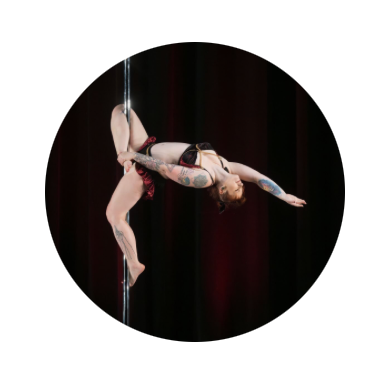
Ballerina needs a combination of shoulder mobility, thoracic rotation, hip mobility, strength and technique. You also need to understand how to create space around the pole, position your hips and use your push and pull arms.
I like to work on those areas separately first, then add specific Ballerina pole conditioning and entries before bringing everything together into the full move.
→ Explore the Pole Rage 6-Week Ballerina Programme
How many times a week should I train for pole dancing?
There isn’t one magic number because it depends on your level, your pole goals and what other training you’re doing.
I generally recommend 2–3 focused training sessions a week, but that doesn’t mean every session needs to be a full pole session. You could combine off-the-pole strength training, pole conditioning, mobility or flexibility depending on what you’re working towards.
The biggest thing is consistency. You’ll get much more from training towards a specific goal consistently each week than doing loads in one week, getting exhausted and then not training again for two weeks.